
Paragraph 1: What if particles are cyclic machines?
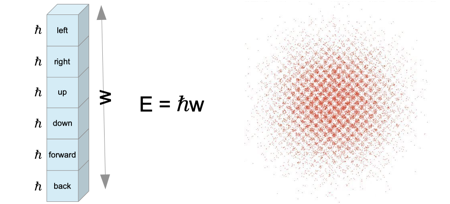
It can be tested through predictions and experiments. It could be the next huge thing.
A machine consists of a list of instructions. Each instruction represents some direction in space:
- left
- right
- up
- down
- forward
- back
The machine executes all its states one after another and moves in the corresponding direction of space by the same discrete distance on each tick of time.
After one state is executed, control is passed to the next state. This happens infinitely in a loop. After the last state is executed, control is passed back to the first state.
So the machine moves and moves until its state is changed.
Properties and phenomena reproduced by this machine
Energy
E is total energy: the total number of states.
The energy of one state is numerically equal to the reduced Planck constant. This is the reason why action is discrete.
Inertia
First Newton’s Law appears because the machine keeps moving infinitely until its state is updated.
The more states the machine has, the more states must be updated, and the more the particle “resists acceleration”.
Limited speed
You cannot move faster than straight.
Discrete action
Interaction is a discrete change. A change in energy equals the energy of one state.
Reduced wavelength
Reduced wavelength is the contribution of one discrete piece in motion.
Uncertainty and observer effect
Interaction destroys the original particle, so you cannot know some properties of the particle after interaction.
The reason is that you cannot fully control which state will be taken from the machine or passed to the machine.
Momentum and conservation of momentum
Momentum is the amount of states that represent motion.
Conservation of momentum follows from the conservation of those directional states during interaction.
Rest mass
Rest mass is the amount of states that represent cyclic motion.
For example, a pair of states left-right does not move the machine anywhere, but it still takes ticks of time to execute.
Speed
If you have a particle RRRR, it moves with the maximum possible speed to the right.
If you have RRRRLLL, it moves right only one moment of time out of seven. So its average speed is 1/7 of the maximum speed.
Photons
Photons generated by a set of particles have more or less the same speed in any direction.
Circular motion
Discrete rules can lead to circular motion.