
Slow photons
We are told that light in vacuum travels at c, regardless of how its source or observer moves. But what if this is not the whole story?
Interestingly, slower propagation in free space has already been demonstrated. Researchers found that spatially structured photons arrived later than their unstructured counterparts. You can read about the experiment in Physics World.
The authors describe this as a reduction in axial group velocity caused by the light’s spatial structure, not a violation of special relativity. Their paper reports a real arrival-time delay, including for single photons.
The delay is real: the structured photons arrived later. The question is what this tells us about their propagation and how we should interpret it.
Below, I propose a different experiment which, according to my model, should generate slow photons by changing the source’s velocity.
Motivation
In my particles are cyclic machines model, particles execute instructions in shared absolute space and time. Within this picture, we need to explain why a moving source would measure the same speed of its own light in every direction.
Let c be the speed of light from a source at rest in the absolute frame, and let v be the speed of a moving source in that frame, with 0 ≤ v < c.
Consider light emitted directly forward. If it travels at c in absolute space while the source moves at v, the distance between them increases at c − v per unit of absolute time.
What if light separates from the source at that same rate in every direction?
This is the proposed emission rule: relative to its source, light spreads in every direction at c − v, measured using absolute time. The forward-light assumption and the extension to all directions are the hypotheses behind this prediction, not consequences of absolute time alone.
For a source moving uniformly, the centre of each expanding light sphere therefore moves along with the source. The light does not leave its centre behind at the emission point.
The prediction
Forward-emitted light has velocity:
v + (c − v) = c.
Backward-emitted light has velocity:
v − (c − v) = 2v − c.
Here, positive velocity means motion in the source’s direction, and both velocities are expressed in the absolute frame.
- Below v = c/2, backward-emitted light travels backwards at speed c − 2v.
- At v = c/2, it is stationary in the absolute frame.
- Above v = c/2, even backward-emitted light moves forwards. It follows the source, although the source moves faster and leaves it behind.
So the prediction is not just that slow light is possible. It is that the propagation of emitted light depends on the source’s velocity in this specific way.
What about clocks?
If light separates from the source at c − v, how could that source still measure c?
Assuming unchanged measuring lengths, its clock would have to tick more slowly by the factor (c − v)/c. An interval Δt of absolute time would register as Δτ = Δt(c − v)/c on the moving clock. The measured speed of its own light would then be:
(c − v)Δt / Δτ = c.
Within my model, this clock slowdown is connected to inertia. I will explain that connection and present the proposed alternative to special relativity in a separate article. Here, I want to focus on the prediction, not the complete account of clocks and motion.
How could we test it?
I propose reflecting light from the edge of a rotating disk, with the reflecting surface moving away from the detector. This applies the proposed emission rule to reflection: the moving surface acts as the source of the outgoing light.
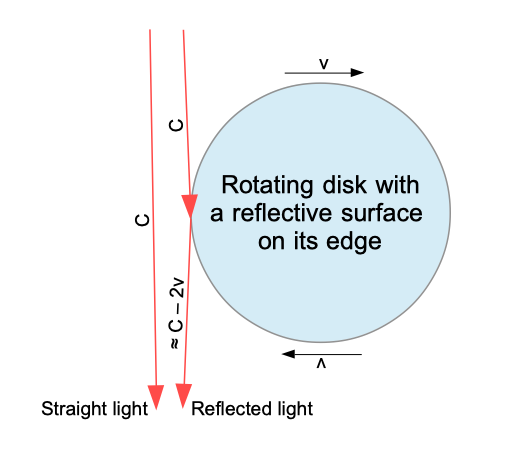
If the surface moves opposite to the outgoing light’s direction, the predicted reflected-light speed is approximately c − 2v for a sufficiently small reflection angle. This is the simplified case in which the laboratory is at rest in the absolute frame and v is the local surface speed, below c/2.
It does not have to be a rotating disk. Any reflecting surface moving away from the detector could serve this purpose. A rotating disk is one possible setup.
You do not have to measure the exact speed directly. Compare the arrival times of reflected light and a direct reference pulse, accounting for their different path lengths. Repeat with the disk stationary and at different rotation speeds to look for an additional delay associated with the surface’s motion.
Simulation
Open the moving-source light simulation.
Compare a moving source with a stationary one and change the source speed. Each pulse’s centre continues moving with the source’s velocity at emission, while its radius grows at c − v in absolute time. At the default source speed of 0.7c, even backward-emitted light moves forwards in the absolute frame.
This illustrates the proposed rule, not an experimental confirmation or a derivation from particle interactions.
For the broader model, see The theory of everything.